
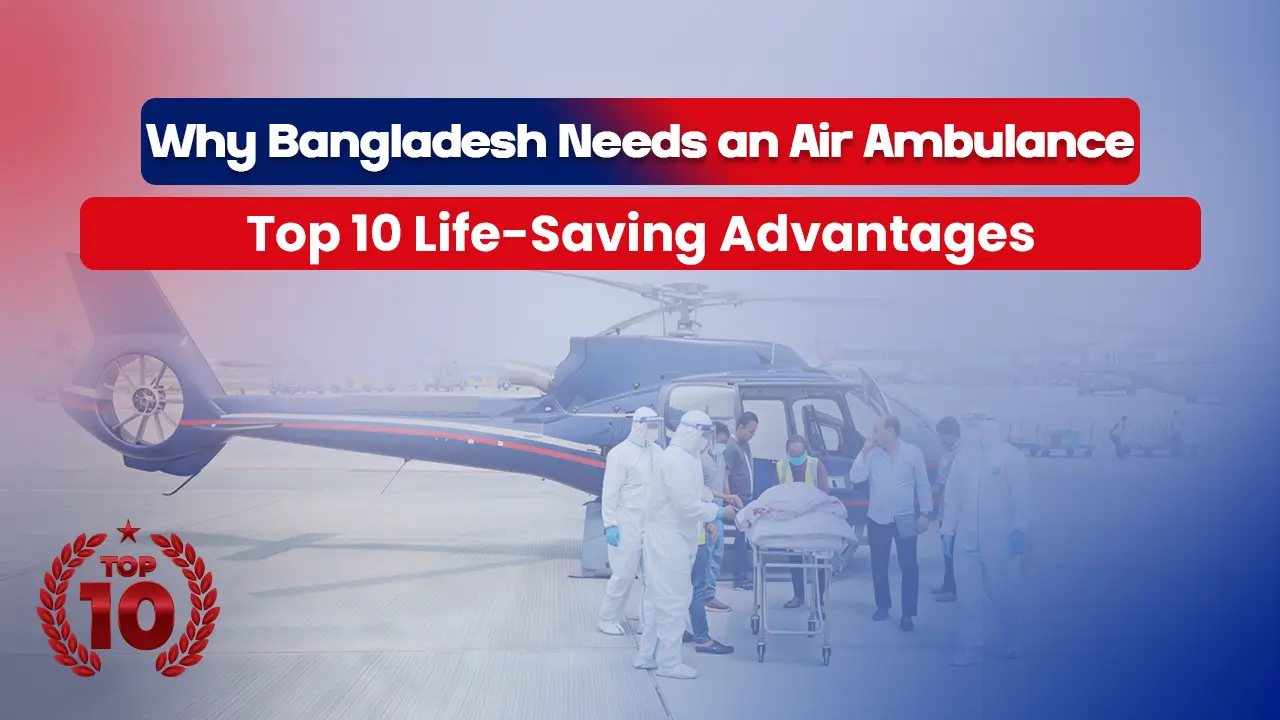
Bangladesh has come a long way in improving public health, and we see progress everywhere. However, air ambulance in Bangladesh is still very important because reaching the hospital fast can save lives.
When someone has a major injury, a stroke, or serious complications during childbirth, every second matters. So, quick medical help is not just helpful — it can make the difference between life and death. Even though the country is growing, road traffic in Dhaka is heavy, and long road journeys from far districts take too much time.
Also, many areas have rivers, remote villages, and islands that become harder to reach during floods. As a result, during storms or natural disasters, ground ambulances cannot always get through. That’s why air ambulances become a safe, fast, and reliable solution. With strong air medical support, Bangladesh can respond faster, save more lives, and stay prepared for emergencies big or small.
What “Air Ambulance in Bangladesh” Means Today
When people search for an air ambulance in Bangladesh, they find many service models. Some are private companies with helicopters and planes. Some flights come through hospitals when a patient needs medical evacuation. And sometimes, during disasters, government or military helicopters help communities.
There are two main types of aircraft: helicopters work best for short trips and hard-to-reach places, while fixed-wing planes work well for long distances or international flights.
Most services offer bed-to-bed care. This means doctors and nurses pick up the patient, travel with them inside the aircraft, and stay with them until they reach the hospital bed. So, care continues every minute of the journey.
Types: Fixed-wing VS Helicopter Ambulances
Helicopters: Hover and land in tighter areas, suitable for rescue from flood-isolated zones or rooftop pick-ups.
Fixed-wing aircraft: Faster and more economical for longer distances and international repatriation.
Service models: Private, government, and hybrid
- Private providers operate 24/7 charters and medical repatriation.
- Hospital-arranged services contract providers when a patient needs urgent transfer.
- Military/government assets (e.g., air force helicopters) step in during major floods and disasters.
Top 10 Life-Saving Advantages of Air Ambulance in Bangladesh
Below are the ten most important benefits that a functional air ambulance network brings to Bangladesh.
1. Rapid access to hospital care
In emergencies, every minute matters. Air ambulances fly fast and reach big hospitals quickly. So, in trauma, heart attacks, or severe infections, fast arrival helps save lives and reduces long-term problems.
2. Better survival in trauma, stroke, and heart attack
With injuries or strokes, treatment time is very short. Doctors often count minutes. And because air ambulances move fast, patients reach the right doctors sooner. As a result, more people survive and recover better.
3. ICU-level care inside the aircraft
Modern air ambulances work like mini ICU rooms in the sky. They carry ventilators, heart monitors, and special pumps. Even more, trained doctors and nurses travel with the patient. So care continues smoothly during the entire flight.
4. Faster help during floods and disasters
When floods cover the roads, cars and vans cannot move. But air ambulances can fly above water and reach people quickly. They can also bring doctors, medicines, and medical help to disaster areas. So they become a lifeline in tough times.
5. Easy access from remote islands and river areas
Many people in coastal islands and char regions live far from big hospitals. Road and river travel may take too long. However, an air ambulance can fly directly and bring them to treatment much faster.
6. Safe transfer for mothers and newborns
Complicated childbirth needs quick medical help. Problems like eclampsia, heavy bleeding, or newborn illness require special hospitals. Air ambulances shorten travel time and protect both mother and baby when seconds count.
7. International medical travel made safe
Sometimes patients need treatment outside Bangladesh. Air ambulances help them travel safely to hospitals in other countries. This supports recovery, medical tourism, and global medical cooperation.
8. Organ transport for transplants
Organs must reach hospitals quickly to stay healthy. Air transport makes delivery fast, safe, and on time. So, more transplant operations become possible, and more lives can be saved.
9. Less pressure on road ambulances
Big cities like Dhaka often face heavy traffic. Ground ambulances get stuck or overloaded. But when air ambulances take long-distance patients, road teams carry fewer loads. This keeps the whole system faster and smoother.
10. Strong support for disasters and health missions
Air ambulances can also carry medical teams, vaccines, and emergency supplies. They reach far areas during outbreaks or disasters. This improves public health and saves communities during crises.
Real Costs and How Families / Hospitals Can Plan
Air ambulance saves lives, but yes, it costs money. The price changes based on the aircraft type, the distance, and how much care the patient needs. Many domestic flights can cost several lakh taka. This cost includes fuel, crew, doctors, and machine support. So, planning early really helps.
Typical cost drivers
- Aircraft type (helicopter vs fixed-wing)
- Flight distance and duration
- Medical equipment and staff required (e.g., doctor, nurse, paramedic)
- Landing fees and ground transfers (road ICU ambulance on either end)
- Night-time or emergency immediacy surcharges
- Payment options and insurance gaps
However, insurance does not always cover air ambulance fully. Sometimes, it depends on the case. Because of this, families may face a sudden bill after an emergency flight. But there are solutions too. People can talk to hospital social workers, charity groups, or even ask for a price negotiation.
Emergency medical insurance with evacuation coverage can also help a lot. So, when families learn about pre-approval steps and prepare a plan early, they feel less pressure during crisis moments.
Challenges to Scaling Air Ambulance Services in Bangladesh
Growing the service is not easy. We need more trained medical teams, aircraft, landing spots, and clear rules. But with teamwork and good planning, we can overcome these hurdles step by step.
For example:
Regulation, trained staff, and equipment needs
Air ambulances require strict aviation and medical regulations. Equally, skilled critical-care flight nurses, flight paramedics, and doctors need specialized training. Investing in workforce development and ensuring equipment standards is essential.
Cost, infrastructure, and landing sites
Operating costs are high. Many districts lack proper landing pads near hospitals or secure helipads. Coordinated planning between aviation authorities, hospitals, and municipalities is needed to build regional landing sites or emergency helipads.
Integration with emergency services
An efficient system requires a unified emergency dispatch and clear referral pathways between district clinics and tertiary hospitals, so an air ambulance is used for the right cases at the right time.
Practical Steps — What Hospitals, NGOs, and Policymakers Should Do
Everyone must work together. Hospitals can train staff, the government can build helipads, and NGOs can support remote areas. When all groups move forward together, more people stay safe.
Build public-private partnerships and regional hubs
Governments can incentivize private providers and partner with hospitals to create regional medevac hubs. This lowers individual provider risk and spreads costs across regions.
Expand training and standard protocols
Create training pipelines for flight paramedics, flight nurses, and doctors. Standardize protocols for triage, referral, and aircraft use to ensure quality and safety.
Integrate with disaster planning
Include air ambulance capabilities in national disaster management plans. Joint exercises with military and civilian agencies improve coordination during flooding or cyclone seasons.
How Families Should Prepare Today
Families can learn early how to call an air ambulance. They can keep medical papers ready and know hospital contacts. With small steps, they stay prepared and stress less when emergencies come.
When to consider an air ambulance
Consider air transfer when:
- A specialist center is needed urgently, and ground time exceeds critical treatment windows.
- Roads are impassable due to flooding or other disasters.
- The patient needs continuous ICU-level care that ground services cannot provide over long distances.
Quick family checklist
- Keep copies of recent medical records and medication lists ready.
- Know your hospital’s transfer protocol and list of preferred air providers.
- Save emergency contact numbers for your hospital, insurer, and the nearest air ambulance provider.
- Ask hospitals to explain expected costs and funding options before transfer, when possible.
Conclusion — A Life-Saving Investment
Investing in an air ambulance in Bangladesh is a smart step. It saves lives. It also reduces the chance of disability later. And even more, it helps the country stay strong during floods, cyclones, and other climate shocks. So, it works like a medical tool and also like a public safety service.
Now, imagine everyone working together. Private companies, government support, hospitals, and better insurance plans — all join hands. Then, more people get fast medical help. Even families living in villages, char areas, and faraway places can reach treatment quickly. So, teamwork makes advanced care possible for all.
FAQ’s
Q: What is an air ambulance in Bangladesh?
Ans: An air ambulance is not just a normal plane — it is like a flying hospital room. Inside it, there are doctors, nurses, and life-saving machines to take care of patients. And because it flies, it can reach hospitals much faster than road ambulances. So, when someone needs urgent treatment, an air ambulance often becomes a true lifesaver.
Q: When should someone use an air ambulance instead of a ground ambulance?
Ans: People usually choose an air ambulance when every second is important. For example, if the roads are blocked, too slow, or very far, then flying is a better and faster way. Also, when someone lives on a river island or in a remote village, an air ambulance makes medical help reachable. And if a patient needs special hospital care right away, then air transfer becomes the best option.
Q: How much does an air ambulance cost in Bangladesh?
Ans: Yes, many air ambulance services are available 24/7. You can call them any time — morning, evening, or even late at night. However, weather conditions, flight permission, and landing space can sometimes affect timing. So, it is always wise to confirm availability when booking to make sure help arrives smoothly.
Q: Does the air ambulance service run day and night?
Ans: Yes, many air ambulance services are available 24/7. You can call them any time — morning, evening, or even late at night. However, weather conditions, flight permission, and landing space can sometimes affect timing. So, it is always wise to confirm availability when booking to make sure help arrives smoothly.
Q: What makes air ambulances different from road ambulances?
Ans: Air ambulances fly fast. They skip traffic and long journeys. Inside the aircraft, doctors can give ICU-level care using ventilators, oxygen, monitors, and medicines. They can also reach places where road vehicles cannot go — like flooded areas or faraway islands. So, they save time and give better medical support during emergencies.
Q: What challenges do air ambulances face in Bangladesh?
Ans: Running air ambulance services is expensive. Aircraft fuel, trained staff, and medical tools cost a lot. Also, many hospitals still do not have proper helipads or landing zones. Weather delays can also happen. And sometimes, families are not aware that this emergency option even exists. These issues slow down the growth of air ambulance care, but step by step, it can improve.
Q: Who can use the air ambulance service in Dhaka or other cities?
Ans: Anyone who needs urgent medical travel can use it — children, adults, seniors, emergency patients, or accident victims. Many services work across Dhaka, Chattogram, Sylhet, Rajshahi, Khulna, Barishal, and even remote island areas. As long as flight clearance and landing space exist, air ambulances can help almost anywhere..
Q: Can air ambulances help during floods or cyclones?
Ans: Yes, when trained teams handle the flight. Pilots, doctors, and medical crews know how to care for patients during travel. They monitor heart rate, breathing, oxygen, and medicines until the patient reaches the hospital. With proper care and planning, air ambulances make travel safe and fast.